Last Monday, I danced in front of a Pollock, moved around a stark room as if I was melting and attempted to embody the matte maroon of a Rothko by rolling around on the floor of a gallery. That was quite a start to the week! Why was I not unceremoniously thrown out of the museum for aberrant behavior?
Long gone are the days when I could get away with that kind of conduct in public with a gap toothed smile and a twirl of the pigtails. I am not even part of the ilk that is expected to disregard such petty considerations as socially acceptable conduct for the sake of art: the performance artist. My frenzy of non-verbal expression was legitimized by the context of the Physical Thinking course led by visual artist Liz Ellis and Suzy Willson, Artistic Director of the Clod Ensemble. They take it upon themselves to teach something simple, so simple in fact that we rarely ever think about it: movement. Liz and Suzy are offering a platform to question the fact that the way we move in galleries has very little to do with the way we are moved by the art we encounter. Actually, they skip the questions, the qualifications and the descriptions in favor of physical expression so the participants move, run, jump, crawl, twirl and leap their interpretation of art.
Chances are, you haven't had such an experience of the museum in a few decades yourself because this is just not usually behavior expected from your average museum audience. What's more, if we were all to launch in spontaneous arabesques in the middle of a crowded gallery, chances are some people might be left with the scarring experience of a crushed foot rather than the elating feeling of expression freed from analytical constraints. But, other than that, who's to say the physical response would be less valid than silent contemplation or a comparative analysis between the work and the information related in the exhibition catalog?
Although I spend most of my time doing the latter, I sometimes find that whatever I might read or say about a work doesn't come close to expressing all that I feel about it. So next time you see someone looking weighted down in front of a Judd or shimmying in front of a Vasarely, just know that it might be me, at a loss for words.
This entry was first published on The Forum
3/07/2008


9/09/2006
Full responsibility
 Two – not one but TWO – works of art fell off the wall during the “Los Angeles 1955-85” Exhibition this Summer at the Centre Pompidou. On two separate occasions – yes, TWO. Don’t they know how to hammer a nail?
Well, apparently, an internal investigation was required in order to answer this question. Although I’ve never witnessed such an investigation, I would imagine that it entails Pompidou president Bruno Racine pointing at curators and art handlers and screaming “YOU, you must be the one to take the blame!” until somebody breaks down and cries.
In the first instance, it would appear that Bruno must have seen quite a few of his good people shed a tear before he obtained a full report. Indeed, the art handler blamed the restorer who blamed the person who then hung the piece who in turn blamed the restorer. Peter Alexander’s untitled 1971 piece is a vertical bar of resin nearly eight feet long. Some people would find it surprising that a big bar of resin should be hung on the Pompidou’s walls but that’s the subject of another discussion. “YOU, you must pay attention!” as Bruno would say.
So Peter Alexander’s untitled 1971 piece was about to be installed when art handlers noticed that a small metal ring inserted into the hanging hole was loose! Oh my! A restorer was immediately called in to glue the metal ring back on. Yes, some people are on-call for their knowledge of glue. She then instructed the people who were to hang the piece (I wonder if they’re called the hangers) to let the glue set for 24 hours. Well it would appear that some of her wisdom was “misinterpreted” because the work was hung that same day. It fell from the wall that very same night.
Now, of course, the Pompidou takes full responsibility, blaming the restorer who was an outside contractor. Bruno said, disapprovingly, that “It is clear the instructions should have been made in a written form.” Yes, had it been done by a glue specialist of the Pompidou, he would have known to make a little sign specifying “YOU, you must LET GLUE DRY FOR A FULL DAY!”
As for the mysterious incident of the falling Untitled Wall Relief of 1967 by Craig Kauffman, Bruno had to admit that his investigation was inconclusive. The convex bubble of acrylic-painted Plexiglas, whose upper edge slotted into a wall-mounted molding, just fell and broke after 130 days of apparently stable display. Then again, Bruno suspects that the hanging might have been flawed. You see, it was fabricated by the lender and its installation was overseen by an objects conservator that was not employed by the Pompidou. What’s more, according to Bruno, if the hanging was flawed, a visitor may have touched the work and dislodged it from its mount leading to its fall later.
Now that’s what I call taking full responsibility…
8/12/2006
It's for your own good
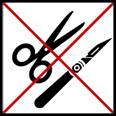
After the foiled terrorist attack on planes going from Britain to the U.S. on the 10th of August, taking a plane will never be the same… until we are distracted by something else and fall back on old habits.
Just a few days ago, I took a plane from Montreal to London with my laptop, two books, a gigantic bottle of water and an eyelash curler. One never knows when an eyelash curler might come in handy. The woman sitting next to me spent most of the flight guzzling a fluorescent sports drink and hugging a teddy bear big enough to take up half her seat. I tried not to pass judgment.
Had we traveled 24 hours later, we would have had a very different experience. After being stripped of shoes, belts and jackets to go through security, all that we could have brought on the plane would have been stuffed in a clear plastic bag allowing for easy screening and quick detection of teddy bears and eyelash curlers because the former can hide a multitude of weapons in its fuzzy belly. As for the latter, well, one never knows when it might come in handy... The restrictive list of the items we are allowed to fly with is now reduced to what could be called necessities:
- Pocket-sized wallets/ purses, plus contents (contents may not include explosives, weapons, any form of liquid, but I guess you can still have a bit of money)
- Passports/ travel tickets (might be a bit complicated to travel without them)
- Prescription medicines, not in liquid form unless verified as authentic (does the security personnel have to take a dose?)
- Essential medical items, eg diabetic kit (considering all these restrictions are apparently aimed at our safety, it was considered best to allow for a few bottles of insulin on board less these safety measures actually cause a passenger's death)
- Glasses & sunglasses, no cases (you might need them to see the films that will be screened to distract you from the fact that you couldn't even bring a book on board because you might have distracted the cabin crew with an impromptu dramatic reading)
- Contact lens holders, no solution (I'm sure Boots is on it's way to developing a dry storage solution but a bit of spit will have to do for now...)
- Baby food & milk for those with infants - bottle contents must be tasted by accompanying passenger (now is not the time for that brussel sprout flavored puree unless you really want to know why your child spits it out more than he swallows it)
- Essential sanitary items for infants (at least children are still allowed a minimum of comfort)
- Female sanitary items, unboxed (so everybody in the plane can know it's that time of the month)
- Tissues, unboxed, or handkerchiefs (because Keys, but no electric key fobs (are Tasers allowed if they're also key rings?)
Sure, it's a very short list considering all that we took for granted as essential to a comfortable flight just a few days ago, but that's nothing compared to the list of items allowed in the British Library's reading rooms: - No bag larger than 29x21x10cm may be taken into the Reading Rooms
- In addition to the above, no more than one clear plastic bag may be taken into the Reading Rooms, and, if required, a clear plastic bag for a lap top computer.
- You must comply with all requests for inspection: staff may open and inspect your personal possessions (including bags, sealed envelopes, folders, personal computers etc) as you enter and leave the Reading Rooms.
- You may not take outdoor coats into the Reading Rooms. Outdoor coats include overcoats, waterproof clothing of any length, outdoor jackets e.g. bomber, quilted, sheepskin, puffer, fleece and leather jackets etc. (This is not a place for fashion)
Items that could harm the collections are not allowed in the Reading Rooms. These include, but are not limited to: pens, food, drink, sweets (including cough sweets), chewing gum, glue, bottles of ink, correction fluid, cleaning liquids, scissors, knives (including craft knives and razor blades), highlighter pens, scanner pens, adhesive tape and umbrellas.
It's not clearly mentioned in these rules and regulations, but eyelash curlers are not allowed either. One never knows when a reader might be tempted to curl a few pages of a rare manuscript in a moment of boredom.
These rules are clearly aimed at the protection of the British Library's collection. It's your right not to respect them, but then you will not be granted access to the collection. In this case, responsibilities and rights are clearly spelled out: respect the rules, get access to the books.
But what are the responsibilities and rights implied by the new rules applied to air travel? We are told that these strictures are meant for our own security so we blindly accept them. Then again, we don't really have a choice if we need to take a flight, so we resort to rationales along the lines of "I don't like it but I'd rather go through that knowing that everybody has to do it which should insures my safety."
I agree that many systems cannot function without rules and regulations, some measure of control, but I start getting a tingly feeling of discomfort when the power to apply these rules is attributed to a rather conceptual entity (Airport Security? National Aviation Security Committee? Department for Transport? U.S. Government? British Government?) and when I'm told it's all for my own good. That's what parents tell their children when they don't want to eat their brussel sprout puree and can’t be bothered to explain why the dreaded green mush should be so beneficial...
7/22/2006
Beyond the Cocoon

I have to admit that the world of art academia which also happens to be “mine” is… sometimes out of touch with, well, everything but the very narrow topics that you can base a PhD on. Academia is like a cocoon in which one can live self sufficiently for long periods of time without much real contact with whatever might be happening beyond the book lined partitions. No matter how much we claim, within the confines of a seminar, that our research is aimed at a wider public or will make a real difference outside of universities, we fail to realize that this “wider public outside of universities” doesn’t know what we do and might actually not care. Why should they want to read 300 pages on the preservation of chocolate sculptures, the motif of walking in visual art and the metaphysical meaning camouflage in architecture. I know I would gladly pour over these morsels of research because it’s just so interesting. How do they come up with such obscure topics? How, exactly, is this supposed to make a difference for the guy behind the counter at the off-license, my GP or my grand-mother? But if you don’t step out of your cocoon often enough, you start taking for granted that everybody can define Modernism at the drop of hat and that nobody could possibly sport a mullet without irony in this day and age.
My wake-up call came last week. You see, my circle of friends in London is comprised mostly of graduate students of art history and cultural studies so the re-hang of Tate Modern’s permanent collection has been at the forefront of our discussions lately. Yes, yes, we really talk about it. A lot. Too much. But it’s important. Really.
On a sunny day, while picknicking in Russel Square after our annual feedback meetings, we were having just such a discussion. It couldn’t have occurred to any of us at the time that, had one of the mildly exhibitionist sunbathers overheard our conversation, he would certainly have thought “What a bunch of ponces! What the hell are they talking about? Why are they not paying any attention to my much too small animal print bathing costume?” Indeed, we wouldn’t have noticed his overexposed, tanned to a crisp nudity because we were aghast with disbelief over the fact that a Lichtenstein picture had made its way in one of the States of Flux galleries! Yes! The wing devoted to the early twentieth-century movements Cubism, Futurism and Vorticism! How ridiculous, how unacceptable. We all agreed and there a minute of silence brought on by the shame that such a thing could happen in such an important museum…
A few days later, I found myself relaying that vital information to S, thankfully not of the art world. I said “I can’t believe a Lichtenstein picture made its way in one of the States of Flux galleries! Yes! The wing devoted to the early twentieth-century movements Cubism, Futurism and Vorticism! How ridiculous, how unacceptable.” Within a second, his expression slipped from blankness to utter amusement. He didn’t even have to reply “Ooooh! You don’t say. Now that’s really horrible.” The smirk on his face was enough to make me realize that certain concerns don’t have much currency beyond the academic cocoon…
Image: © Estate of Roy Lichtenstein/DACS 2002
Subscribe to:
Posts (Atom)