Here I was in the middle of a gallery, kneeling on the floor with my eyes closed, caressing an arte povera bronze sculpture. Still, no security guard materialised to interrupt my fondling the art. That’s because I had relinquished my sight for a few minutes in order to experience part of a Touch Tour, one of these special guided visits that most public museums organise for visually impaired visitors.
I’d had a good look at the big lumpy sphere before touching it and the kindly curator of Access and Special Events had explained its origins and its significance to me, pointing out that visitors especially liked to kick this piece. Although this tale of hardship was quite touching, the protuberance inspired no sympathy, but the feeling of its cool, hard surface under my gloved hands was quite pleasant on this warm day. By giving it a little tap I could feel that it was hollow, hence a lot lighter than it looked, yet still immovable – even with a good kick. The fact was that touching this artwork, even through cotton gloves, was a great deal more pleasant than looking at it.
When I opened my eyes about a dozen people had gathered around to watch the unusual scene. Most were probably waiting for the police to drag me away, kicking and screaming, from the artwork I was hugging but a few just wanted to know what on earth I was doing and why I was allowed to break the rules of the institution. I left the kindly curator to deal with the angry mob as I had to go to another gallery for a similar tour with a group.
When I got to the museum, five partially sighted elderly ladies were patiently waiting for me. They had been kind enough to accept me in their group and wanted to know all about my research, asking questions (Aren’t you a little old to be a student dear?) and volunteering valuable information (I have a son who’s single and he has done studies too) even as the guide was explaining the rules of the tour. After spending about fifteen minutes removing all jewellery and donning attractive latex surgical gloves, we set out to touch our first artwork: a life sized male nude.
The ladies didn’t seem too taken with the history of this handsome bronze archer, but when the time came to touch, their interest was renewed. They somehow mostly avoided the naughty bits and concentrated on the height and the posture, commenting either on the material (Oh! It’s cold!) or on the form (He looks just like my son who’s single and who has done studies), but when the last participant approached the sculpture, she looked so frail next to this epitome of virility that I somehow feared she would be crushed. Yet, she felt her way around the torso, then moved the tips of her fingers gingerly down both arms and as she wrapped her arms around the sculpture she let out a high pitched exclamation: Oh! He has such a nice bum! Maybe she couldn’t rely on sight anymore be she could still clearly appreciate the aesthetic value of the piece.
As the ladies cackled I could only reach one conclusion: art is much more pleasurable when it can be touched.
5/13/2006


4/05/2006
The Loaded Silence
The grey-blue carpet fades into the grey-green walls which in turn seem to slowly absorb a bumbling speaker swathed in a grey-brown three piece tweed suit. Maybe this blurring is caused by the lack of fresh air or by the obligation to sit still and silent for hours on end, but most elements that constitute an academic conference tend to blend into each other in such a way, leaving the conferees with an indistinct impression of their day – with the exception of one’s own presentation, of course.
Yet, there is usually one aspect that stands out as the hallmark of each event, no matter how uniform. Whether it’s the utter incompetence or the dazzling charisma of a speaker, the quality of the catering or finding out that someone else is writing on what you thought was YOUR topic, these elements of surprise are usually one of the redeeming values of the academic conference.
It’s with this thought that I coaxed myself out of bed at 6h a.m. on Monday morning to take a train that would lead me to one such event. I didn’t have to wait very long to be shocked as the first speaker, an elderly professor leaning on the lectern for actual support more than for dramatic effect, referred to “negroes” as a “minority group often the target of disgust”.
I believe that my jaw fell to my knees at the utterly racist turn that his paper was taking. There was a light rustling sound likely to have been caused by the cringing discomfort of a room full of academics confronted by a politically incorrect statement issued by a peer.
When the speaker stopped reading and the question period started, any mention of the slur was carefully avoided, so carefully in fact that nobody spoke. Perhaps nobody dared add to the significant discomfort that was already felt, but after a few seconds of loaded silence, it was obvious that only the lectern was still supporting him.
Yet, there is usually one aspect that stands out as the hallmark of each event, no matter how uniform. Whether it’s the utter incompetence or the dazzling charisma of a speaker, the quality of the catering or finding out that someone else is writing on what you thought was YOUR topic, these elements of surprise are usually one of the redeeming values of the academic conference.
It’s with this thought that I coaxed myself out of bed at 6h a.m. on Monday morning to take a train that would lead me to one such event. I didn’t have to wait very long to be shocked as the first speaker, an elderly professor leaning on the lectern for actual support more than for dramatic effect, referred to “negroes” as a “minority group often the target of disgust”.
I believe that my jaw fell to my knees at the utterly racist turn that his paper was taking. There was a light rustling sound likely to have been caused by the cringing discomfort of a room full of academics confronted by a politically incorrect statement issued by a peer.
When the speaker stopped reading and the question period started, any mention of the slur was carefully avoided, so carefully in fact that nobody spoke. Perhaps nobody dared add to the significant discomfort that was already felt, but after a few seconds of loaded silence, it was obvious that only the lectern was still supporting him.
3/29/2006
Art will cover the world
Foreboding electronically controlled gates opened before us and we stared at each other, hesitant to walk forth into what looked like the parking space of any industrial storage facility.
After going through a security screening and signing a form waving all kinds of rights we rarely ever thought about, we expected to enter a sacred mausoleum of some kind or at the very least a version of Ali Baba’s cave: rooms filled with glittering artistic treasures, crown jewels of Britain’s art world. Instead, in the decidedly cold controlled environment of the museum store, we were surrounded by crates piled high, dusty plastic covers, glass cases and retractable screens. The art in storage looked somewhat gritty, a Giacometti sculpture wedged between a Beuys blackboard and a Kieffer painting suddenly felt a lot more accessible than the very same artwork elevated on a plinth, strategically lit and accompanied by a facetious wall text.
A nice man gave us a guided tour of the facilities. He told us all about the major obstacles to the preservation of art: humidity, de-accession policies, theft, arson, insects. But he assured us that all these threats were more or less under control. In fact, the preservation team was doing such good work that the store would soon have to expand, taking over a great part of the area. An expression of terror glazed his blue eyes as he went on “In fact, if we keep on like that, the earth will eventually be covered in art.”
We could all adopt a work of art to liberate the overcrowded stores of our national museums. For instance, I could live with a Giacometti sculpture in my lounge and use a Beuys blackboard to write weekly “to do” lists. The world would be a museum as Baudrillard argues when he states that, were museums really democratic, they would be taken apart by the people who could claim a right to bits and pieces of it.
I’m not sure that was exactly what our guide meant, but I would not be surprised if one day his fear of art taking over the world got the better of him and he smuggled a termite colony into work.
After going through a security screening and signing a form waving all kinds of rights we rarely ever thought about, we expected to enter a sacred mausoleum of some kind or at the very least a version of Ali Baba’s cave: rooms filled with glittering artistic treasures, crown jewels of Britain’s art world. Instead, in the decidedly cold controlled environment of the museum store, we were surrounded by crates piled high, dusty plastic covers, glass cases and retractable screens. The art in storage looked somewhat gritty, a Giacometti sculpture wedged between a Beuys blackboard and a Kieffer painting suddenly felt a lot more accessible than the very same artwork elevated on a plinth, strategically lit and accompanied by a facetious wall text.
A nice man gave us a guided tour of the facilities. He told us all about the major obstacles to the preservation of art: humidity, de-accession policies, theft, arson, insects. But he assured us that all these threats were more or less under control. In fact, the preservation team was doing such good work that the store would soon have to expand, taking over a great part of the area. An expression of terror glazed his blue eyes as he went on “In fact, if we keep on like that, the earth will eventually be covered in art.”
We could all adopt a work of art to liberate the overcrowded stores of our national museums. For instance, I could live with a Giacometti sculpture in my lounge and use a Beuys blackboard to write weekly “to do” lists. The world would be a museum as Baudrillard argues when he states that, were museums really democratic, they would be taken apart by the people who could claim a right to bits and pieces of it.
I’m not sure that was exactly what our guide meant, but I would not be surprised if one day his fear of art taking over the world got the better of him and he smuggled a termite colony into work.
3/09/2006
Travel: a Good Lesson in Ignorance
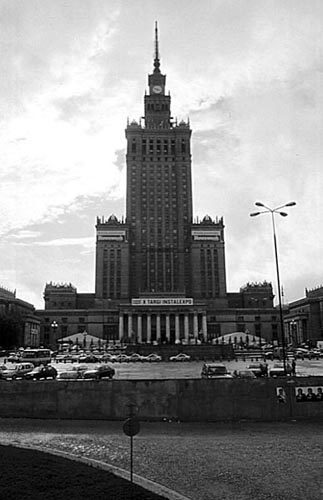
If it is true that travel broadens the mind and raises the spirits, it is also true that it can drastically shrink your shrewdness and lower your ability to communicate.
I was reminded of that while spending an academic weekend in Warsaw. At Luton airport, having a coffee in the departure lounge, I felt confident that I would easily find my way around. After all, I was equipped with a Rough Guide and an extensive Polish vocabulary consisting of yes (tak), no (nie), thank you (dziękować) and the name of my gracious host (Wojtek). Warsaw would be my oyster.
As I tucked in for the night in a child-sized cot set up in a room I was to share with two of my colleagues for the next three days, I was reminder of how small an oyster could be. Did that dampen my spirits? Absolutely not! Between museum visits and talks about art all delivered in infinite variations of accented English, I inflicted my knowledge of the local language on whoever was at hand.
When a kind academic refilled my beer at dinner and I responded with a resonant “dziękować”, I found myself trapped in an even tighter corner than my sleeping quarters: the kind man enthusiastically responded in long tirades of perfect Polish which made no more sense to me than any other series of soft and hard sounds. I resorted to the one viable option I could think of: smile and nod in the hope that nobody would notice my utter bafflement. When my subterfuge seemed to work and the deluge of sounds kept coming, I shed my pride and resorted to the ultimate option. Still smiling, I called out: “Wojtek!”
If I couldn’t hold up my own in a conversation without sounding like an opinionated yet polite three year old child, at least I had a friend who could translate.
Subscribe to:
Posts (Atom)