Foreboding electronically controlled gates opened before us and we stared at each other, hesitant to walk forth into what looked like the parking space of any industrial storage facility.
After going through a security screening and signing a form waving all kinds of rights we rarely ever thought about, we expected to enter a sacred mausoleum of some kind or at the very least a version of Ali Baba’s cave: rooms filled with glittering artistic treasures, crown jewels of Britain’s art world. Instead, in the decidedly cold controlled environment of the museum store, we were surrounded by crates piled high, dusty plastic covers, glass cases and retractable screens. The art in storage looked somewhat gritty, a Giacometti sculpture wedged between a Beuys blackboard and a Kieffer painting suddenly felt a lot more accessible than the very same artwork elevated on a plinth, strategically lit and accompanied by a facetious wall text.
A nice man gave us a guided tour of the facilities. He told us all about the major obstacles to the preservation of art: humidity, de-accession policies, theft, arson, insects. But he assured us that all these threats were more or less under control. In fact, the preservation team was doing such good work that the store would soon have to expand, taking over a great part of the area. An expression of terror glazed his blue eyes as he went on “In fact, if we keep on like that, the earth will eventually be covered in art.”
We could all adopt a work of art to liberate the overcrowded stores of our national museums. For instance, I could live with a Giacometti sculpture in my lounge and use a Beuys blackboard to write weekly “to do” lists. The world would be a museum as Baudrillard argues when he states that, were museums really democratic, they would be taken apart by the people who could claim a right to bits and pieces of it.
I’m not sure that was exactly what our guide meant, but I would not be surprised if one day his fear of art taking over the world got the better of him and he smuggled a termite colony into work.
3/29/2006


3/09/2006
Travel: a Good Lesson in Ignorance
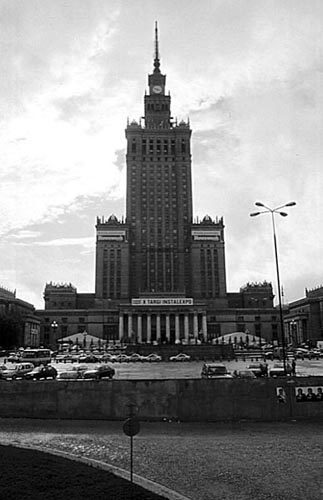
If it is true that travel broadens the mind and raises the spirits, it is also true that it can drastically shrink your shrewdness and lower your ability to communicate.
I was reminded of that while spending an academic weekend in Warsaw. At Luton airport, having a coffee in the departure lounge, I felt confident that I would easily find my way around. After all, I was equipped with a Rough Guide and an extensive Polish vocabulary consisting of yes (tak), no (nie), thank you (dziękować) and the name of my gracious host (Wojtek). Warsaw would be my oyster.
As I tucked in for the night in a child-sized cot set up in a room I was to share with two of my colleagues for the next three days, I was reminder of how small an oyster could be. Did that dampen my spirits? Absolutely not! Between museum visits and talks about art all delivered in infinite variations of accented English, I inflicted my knowledge of the local language on whoever was at hand.
When a kind academic refilled my beer at dinner and I responded with a resonant “dziękować”, I found myself trapped in an even tighter corner than my sleeping quarters: the kind man enthusiastically responded in long tirades of perfect Polish which made no more sense to me than any other series of soft and hard sounds. I resorted to the one viable option I could think of: smile and nod in the hope that nobody would notice my utter bafflement. When my subterfuge seemed to work and the deluge of sounds kept coming, I shed my pride and resorted to the ultimate option. Still smiling, I called out: “Wojtek!”
If I couldn’t hold up my own in a conversation without sounding like an opinionated yet polite three year old child, at least I had a friend who could translate.
2/22/2006
No! Why? What if... Aaargh. All right then!
Why do we rely so much on things that we know so little about?
Take, for instance, a computer. Used on a daily basis for various tasks, this wonderful machine allows you to surf the Internet, to consign your every precious thought for posterity, to fill your tax report and to play chess. It easily becomes your main means of communication with the world, your most discreet confidant, the repository of all your knowledge. It is an extension of you. Your computer improves your life in significant ways. That is, until it starts ruining it.
Indeed, one day your computer starts freezing, gives you incomprehensible messages when you are asking it to perform simple tasks or simply stops responding to your input, turns a deaf ear to your supplications. Then you go through the five following stages :
- Denial and isolation : there is no real problem with it. If I just turn it off and leave it in a corner for a while, it will be fine the next time I turn it on.
- Anger : The bloody thing is still not working the next time you attempt to use it and you are angry at it for the hurt it inflicts on you. You may even be angry with yourself for letting this take place even if, realistically, nothing could have stopped it.
- Bargaining : At this stage, you consider making bargains with your computer such as, "If I change your hard drive or give you a brand new antivirus, will you agree to be functional again?"
- Depression : You feel numb and have lost hope. The mere sight of the computer makes you want to crawl under your bed and spend a few weeks lying there in complete immobility.
- Acceptance : When the anger, sadness and mourning have tapered off, you simply accept the reality of the loss and start shopping for a new computer.
As you might have guessed by now, I have gone through these stages lately when the laptop expired. I had been using this computer for three years to write this blog, my thesis, my lectures, my essays, my emails and many other things when it presented me one afternoon with a blank screen.
I spent a week trying to put my limited knowledge of computer technology to the test, then wasted another pestering about the fact that I had to rely on somebody who knew more than I did – and who would bill me accordingly.
If I must rely on my computer, I should also be able to repair it myself, I thought. But then I would not have sufficient time to write this blog, my thesis, my lectures, my essays, my emails and many other things...
I’m still on stage two about this one.
2/10/2006
The Beasts in the Museum (part 2): The hyenas
.jpg)
Hyenas are social carnivores that live in groups called clans. Within the hyena clan, there is a strict, linear dominance hierarchy: the animals who rank the highest are called the Art Critics and their rank allows them to take preferred resources (the best canapés and the spot closest to the artist) away from lower-ranking animals: the Art Students.
As lower ranking hyenas become more accustomed to the rules of the museum openings, they grow bolder. At first, they limit their activities to smaller galleries where only the occasional wine served in a disposable glass or cheap lager can be found. They also tend to stay pretty close to the door in case they might have to run. After a few months of such training, the hyena cubs leave the safety of the local galleries in favour of the larger institutions. Museums are large and full of danger for young cubs who don't know their way around; so cubs who have recently "graduated" from the local galleries usually stay tucked away in corners when the other members of their clan are nowhere to be found. The art students begin to observe and follow the art critics, freelance writers and other more experienced hyenas around to openings and press conferences and start to learn their way around the territory. Hyenas can live off such social gatherings quite comfortably for prolonged periods.
Most people think of hyenas as dirty, cowardly scavengers. Hyenas are indeed scavengers, but so are lions, commonly known as curators. Scavengers simply live off things that they did not make: art, institutions, food, etc. When lions scavenge, they usually appropriate goods from smaller predators, such as artists.
Lions are picky scavengers ― after all, they make a career out of it ― and when they abandon an exhibition (or a buffet), there is still plenty of food left for the hyenas. Hyenas are fast eaters, and they can go through two, even three openings in one day! Low-ranking hyenas seem to eat and drink the most, probably because they don't know when their next meal will be.
Hyenas make a noise that sounds like a maniacal laughter to signal submissiveness, usually when they’ve had a few too many glasses of free wine on an empty stomach and lack the vocabulary with which to express their perceptions of puzzling or bad artworks. Besides laughing, hyenas make many other vocalizations, the most famous being “This is so derivative”, a call that allows hyenas to signal that they belong to the clan.
Subscribe to:
Posts (Atom)